
Scaling IP Reuse
IP reuse is mission-critical for semiconductor companies. Reusing proven IP is one of the most powerful levers available to compress schedules and reduce risk.
The IP Lifecycle Challenge Is Getting Harder
There are multiple challenges to address to scale IP lifecycle management while keeping the engineering overhead low.
Before the IP can be readily searchable and accessible from a centralized source, it must be packaged with metadata (bugs, assertions, constraints, electrical parameters, simulation results) and formatted to company publishing standards. Doing this manually is a developer time sink and a bottleneck to keeping proven IP out of the catalog – making it unavailable to the teams who need it.
Further, without automated change tracking, notifications, and defect propagation, an IP update — including a critical bug fix — may never reach the design teams whose projects depend on that IP.
7 Ways to Efficiently Scale IP Lifecycle Management
Effective IP lifecycle management starts with getting seven fundamentals right.
1. Capture IP at enterprise scale, from any source. IP should be able to be pulled in from anywhere – third-party IP providers, internal design teams, legacy design data management systems, and Git repositories, without forcing disruptive data migrations or abandoning existing engineering investments.
2. Centralize IP in a searchable catalog. A centralized IP catalog gives IP consumers a place to search and access IP across the enterprise, with controlled visibility, licensing information, access restrictions, and real-time status.
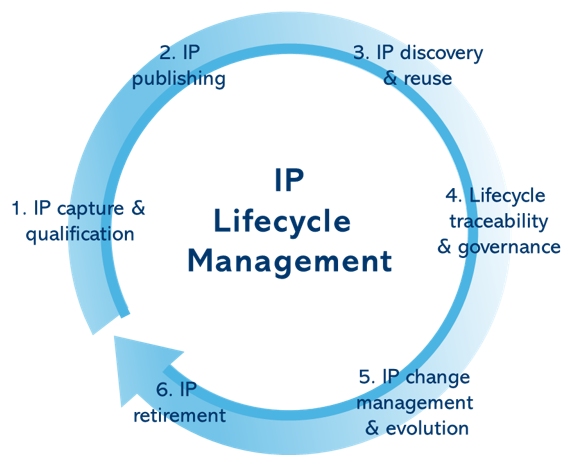
3. Govern the full IP lifecycle, from capture through retirement. Effective IP lifecycle management should securely cover every stage: capture and qualification, publishing to the central catalog, discovery and reuse, change management and evolution, and retirement.
4. Anchor IP management to a single source of truth. IP status, usage, and configuration information must be tied to what engineers are actually building, rather than a potentially outdated snapshot from the last manual update.
5. Automate the manual effort with AI. The packaging, qualification, and discovery workflows that consume significant developer time are well-suited to AI automation. Applied correctly, generative and agentic AI can dramatically reduce manual effort, such as replacing the extensive effort for developers to package their IP and metadata, including bugs, assertions, constraints, and key electrical and simulation parameters, according to each company’s IP publishing standards.
6. Trace IP end-to-end, across the full design hierarchy. Complete, fine-grained traceability of every IP instance and its usage across the full design hierarchy — from initial requirements through post-silicon — is the foundation for compliance reporting and audit readiness.
7. Integrate change management. When IP is updated, the teams whose designs are affected should be notified immediately — and fixes need to propagate systematically across all affected designs. Change management integrated into the IP lifecycle workflow closes the gap between IP updates and engineering response.
IC Manage GDP-AI for IP Lifecycle Management
IC Manage GDP-AI directly addresses each of these seven requirements.
1. Capture IP at enterprise scale. GDP-AI scales to 100M+ IP components and thousands of users, capturing IP from third-party sources, all commercial design data management systems, and Git — eliminating disruptive data migration and preserving existing engineering investments regardless of where IP was created.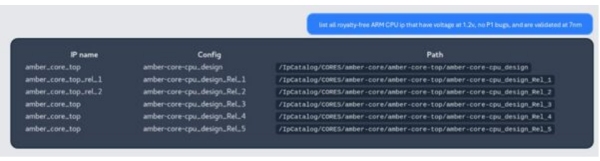
2. Searchable, centralized IP catalog. GDP-AI publishes IP to a centralized catalog, with API integrations that update metadata from external PLM and tapeout systems throughout the day to keep search results live and current. IP consumers use conversational queries for IP discovery. GDP-AI interprets intent and returns the best-suited IP and configurations for the designer to assess. Custom datasheets are dynamically rendered, including links to external systems such as documentation management and bug tracking.
3. Securely governs full IP lifecycle. GDP-AI manages IP through every stage — capture, qualification, publishing, discovery, change management, and retirement — enforcing programmable, finite-state-machine-governed workflows at each stage. Real-time dashboards provide visibility into IP status, usage, and readiness across all projects, while generative AI resolves semantic documentation inquiries, ensuring only actual bugs are escalated to IP developers.
4. IP management tied to single source of truth. GDP-AI ties every IP instance and version directly into the live design database, providing configuration-aware IP search and datasheets with precise visibility into IP content, including inherited metadata, such as status and usage, across every level of the IP and design hierarchy.
5. AI-driven IP lifecycle management. GDP-AI replaces extensive manual IP packaging effort with an automated, AI-driven workflow. IP developers can instead point GDP-AI to their workspace, and the embedded generative and agentic AI interprets the disparate formats IP developers use naturally (PDFs, bug trackers, simulation outputs), extracts and structures the required metadata, and packages it to company publishing standards for developer review and approval for entry into the central IP catalog.
6. Hierarchical, end-to-end IP tracing. GDP-AI tracks IP and metadata across the full design hierarchy, with traceability spanning requirements, third-party licensing obligations, verification and regression results, pre-tapeout bugs, and post-silicon bugs across all design derivatives — enabling engineers and managers to generate a full, audit-ready compliance report at any time.
7. Integrated change management. Change requests, updates, and issue tracking are managed through integrated workflows with Jira links, automatic notifications to project teams when IP is updated or impacted, and AI-driven IP support to filter documentation inquiries from actual bugs — ensuring fixes are systematically propagated across all affected designs.
For information on IC Manage GDP-AI for Lifecycle Management, please visit: https://www.icmanage.com/ip-lifecycle-management-silicon-gdp-ai/
About IC Manage
IC Manage is the design and IP management industry leader. It defined the IP management category in 2011 and has continued that leadership. Today, IC Manage GDP-AI is trusted by Altera, AMD, Infineon, Microchip, NVIDIA, Qualcomm, Samsung, Viasat, and dozens of other leading semiconductor and systems companies.