
Real Intent’s new Microarchitecture Analysis technology lets us achieve a 20X improvement in Meridian CDC’s violation report precision. Traditionally, clock domain crossing tools have relied on structural analysis, so violations can only be analyzed and classified based on elements such as clocks, resets, synchronizers, and FIFOs.
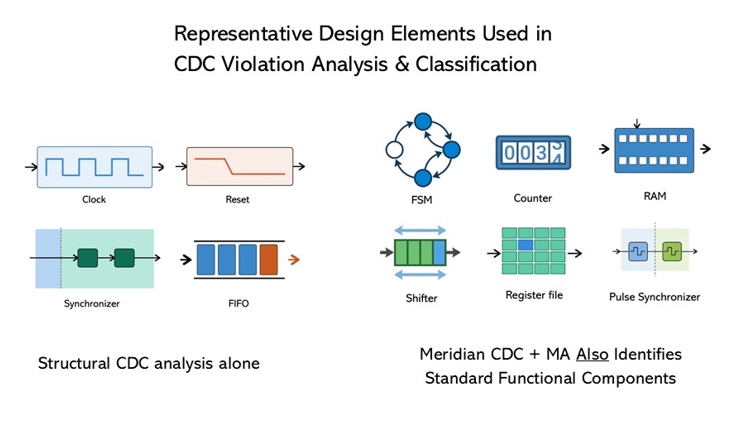 By using Microarchitecture Analysis, Meridian CDC can now also infer functional intent directly from the design RTL to identify key standard functional components, such as FSMs, counters, RAMs, shifters, register files, and pulse synchronizers.
This additional microarchitectural context is what lets Meridian CDC report violations with up to 98 percent precision — this reduces the engineers' review burden by up to 95 percent.
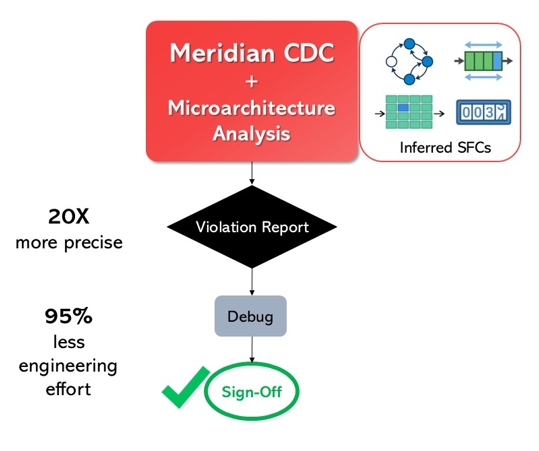
As an example of how this reduces false positives, let’s look at this handshake synchronizer. Traditional structural-only clock domain crossing analysis would flag the handshake as safe or unsafe merely by checking that combinational connectivity exists.
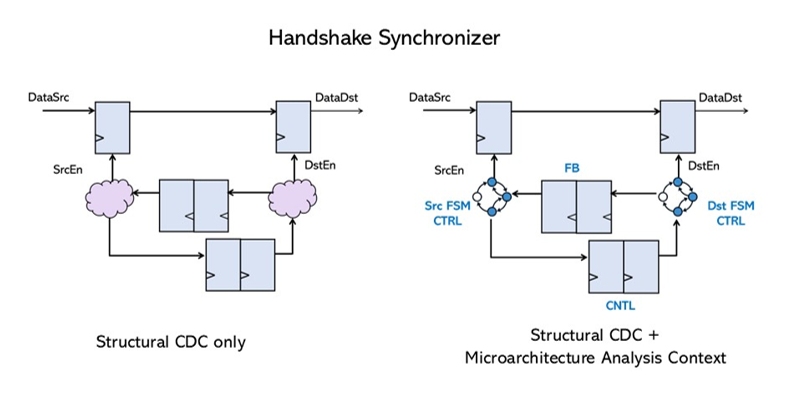 Meridian CDC used microarchitecture analysis to recognize that the source and destination enables SrcEn and DstEn are FSM-controlled outputs, backed by a functional understanding of those FSMs rather than treating them as arbitrary gates.
It can therefore prove that the data remains stable throughout the handshake and that the enables are generated correctly according to the functional protocol, so no metastability can occur. This automatically eliminates the false-positive violations that would otherwise require manual review, constraints, formal proofs, or waivers.
###
For more information, please visit: https://www.realintent.com/clock-domain-crossing-meridian-cdc/