
Microarchitectural integrity sign-off uses static analysis and verification to ensure that standard functional components (SFCs) within an RTL design operate according to their expected design intent.
Examples of standard functional components, or SFCs, include FSMs, FIFOs, counters, and shifters.
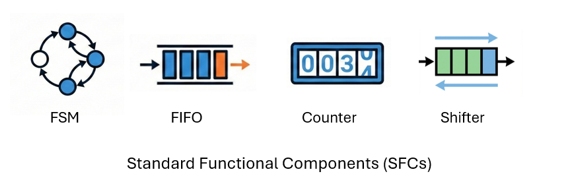
Signing off on the integrity of the design’s standard functional components enables detection of subtle, hard-to-detect bugs at their source versus trying to debug the resulting data corruption or data loss that can result when the bugs propagate through the design.
Advanced microarchitectural integrity sign-off
An advanced microarchitectural integrity sign-off methodology has four key steps:
1. Identify the standard functional components (SFCs) in an RTL design and infer each SFC’s intended functional behavior.
This can be challenging to do when there are many different coding styles, and the logic is functionally split across multiple modules. Advanced tools will infer these.
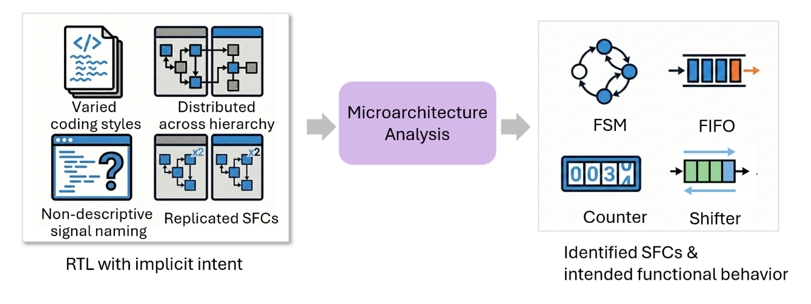
2. Check the integrity of each SFC. Below are two examples.
- FIFO read / write control mismatch. Verify that the read/write counters and their associated empty/full control signals use the same reset signal and consistent reset values.
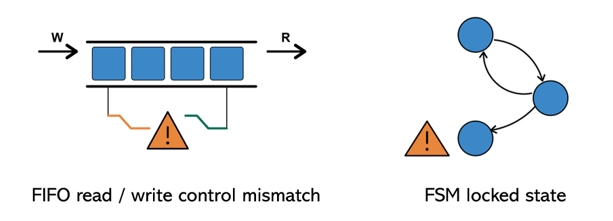
- FSM locked state. Verify that all states can be exited to prevent a lockup condition.
3. Check for proper SFC usage in the design. Three examples are:
- Counter out-of-range. Verify that counters are being compared against values that are within the inferred operational counter range. Comparisons to values outside the operational range of the counter will result in an always true or always false condition, which is likely unintentional.
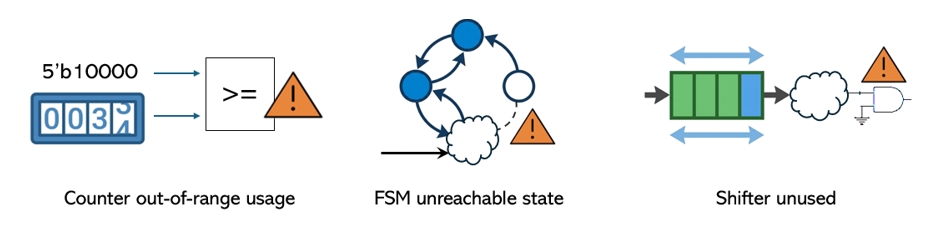
- FSM unreachable state. Verify that all states defined in an FSM can be reached. Extraneous states are likely unintentional.
Shifter unused. The output of the shifter does not influence any primary outputs of the device, either because it is always blocked or the design is incomplete. Extraneous shifters are likely unintentional.
4. Visualize different levels of standard component abstraction for advanced debug, such as an FSM diagram. 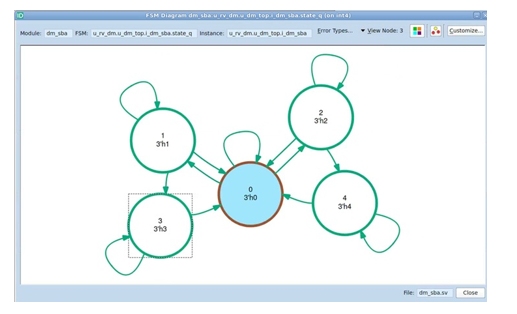
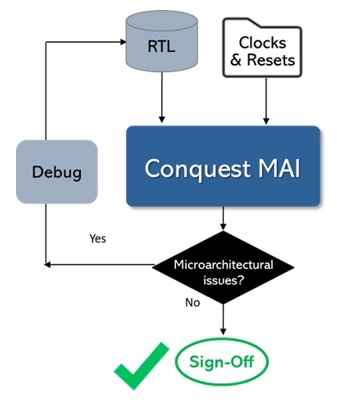
Real Intent Conquest MAI supports all four of these steps.
- Conquest MAI automatically infers standard functional components (SFCs), even when they are distributed across the design hierarchy or obscured by varied coding styles.
- The product performs automatic checks early in the design flow to verify microarchitectural integrity, both in terms of the integrity of the SFCs and their proper usage in the design These checks use minimally Boolean techniques, unlike formal tools, which can exceed practical formal verification capacity limits and are impractical to target using simulation.
- Conquest MAI accelerates debug by generating appropriate graphics of the SFC’s inferred functional intent, including FSM diagrams and SFC functional block schematics, and detailed component schematics.
For information on Real Intent Conquest MAI, please visit: https://www.realintent.com/microarchitectural-integrity-sign-off-conquest-mai/