
Industrial automation and digital manufacturing are evolving rapidly as Edge AI models are reducing latency by bringing intelligence directly to factory floors, production lines, and Industrial IoT systems. Instead of only collecting data and sending it to the cloud for analysis, organizations can now process information and make decisions instantly right where the action is happening.
As industrial environments become more connected, the amount of operational data being generated has increased significantly. Sending all workloads to centralized cloud servers can introduce latency, bandwidth dependence, and connectivity issues. In time-sensitive manufacturing environments, even small delays can impact production efficiency, system reliability, and operational continuity.
At the same time, concerns around data privacy, security, and regulatory compliance are encouraging organizations to process sensitive information closer to where it is generated. Edge AI helps address these challenges by enabling localized inferencing on devices and gateways, accelerating real-time operations, reducing latency, lowering bandwidth usage, and improving overall reliability while reducing dependence on centralized infrastructure.
However, building Edge AI solutions at scale requires more than simply running AI models locally. Enterprises also need deployment-ready engineering frameworks that simplify hardware integration, orchestration, and lifecycle management across diverse edge environments. This is where MosChip DigitalSky GenAIoT helps accelerate practical and scalable Edge AI adoption across industrial and connected product ecosystems.
MosChip DigitalSky GenAIoT is a modular accelerator suite that brings together pre-built AI, Edge AI models, and GenAI solutions for intelligence. Designed on a Plug → Customize → Deploy model, it gives industrial teams a structured, reusable model to move from early AI experimentation to full-scale production deployment faster, without rebuilding foundational capabilities from scratch.
Accelerating Edge AI Deployment with MosChip DigitalSky GenAIoT
Bridging Open-Source AI with Industrial Deployment
MosChip DigitalSky GenAIoT addresses one of the biggest challenges in Edge AI adoption today: turning open-source AI models into industrial solutions.
The open-source AI ecosystem has grown rapidly in recent years, especially across Industrial IoT and connected product development.
Frameworks such as TensorFlow Lite, ONNX Runtime, YOLO (Yolov5, Yolox, etc.), ResNet, NVIDIA NEMO, and TinyML give engineering teams access to developing powerful Edge AI models for use cases such as predictive maintenance, quality control, worker safety monitoring, and industrial process analytics.
These frameworks provide a strong starting point for AI innovation, but deploying them reliably in real-world environments is often much more complex than expected.
In actual production environments, you need optimized models for resource-constrained hardware, manage embedded deployment challenges, maintain compatibility across different silicon platforms, and ensure consistent real-time inferencing performance.
In large-scale industrial deployments, managing and scaling these AI workloads across distributed devices and gateways adds another layer of complexity. As a result, development cycles become longer, engineering effort increases, and time-to-market slows down.
This is the reality that many industrial teams face while enabling AI in their industrial environments, and that is exactly the gap MosChip DigitalSky GenAIoT is built to bridge. Instead of starting from scratch every time, organizations get a curated set of pre-built engineering accelerators for IoT enablement.
It consists of four suites, among which is the Cognitive Intelligence Suite that has 100+ AI models, 50+ Edge AI models, and 20+ GenAI Solutions, all of them are pre-built and reusable.
Faster Edge AI Adoption
When industrial teams evaluate Edge AI deployment, the most common bottleneck is not the model itself; it is the gap between the concept and a working prototype.
The Cognitive Intelligence Suite, part of MosChip DigitalSky GenAIoT, is specifically built to close that gap, delivering 50+ Edge AI models that organizations can deploy by fine-tuning the model to their use cases, enabling up to 40% faster time-to-production compared to building from the ground up.
These Edge AI models are built across vision, audio, video, and sensing domains.
It helps in significantly cutting the engineering effort typically required to develop Edge AI models. It gives you a significant head start in product development, enabling faster time to market.
The suite also provides hardware-optimized inferencing support across leading silicon platforms, including NVIDIA, Qualcomm, NXP Semiconductors, Renesas Electronics, AMD-Xilinx, Lattice Semiconductor, and Infineon Technologies.
Since AI inferencing behaves differently across hardware architectures, the model performance is tuned for the specific hardware in use, without requiring teams to optimize every deployment manually.
As a result, organizations across industrial automation, smart manufacturing, automotive, and critical infrastructure can move from AI evaluation to full-scale deployment faster, backed by models that are already proven and built for real operational conditions.
As more enterprises experience the practical benefits of structured Edge AI deployment across factory floors and connected industrial environments, open-source Edge AI adoption continues to grow rapidly across industries.
Why Enterprises are Accelerating Open-Source Edge AI Adoption
The shift toward open-source Edge AI is being driven by practical advantages that cloud-based systems often cannot deliver in time-sensitive industrial environments.
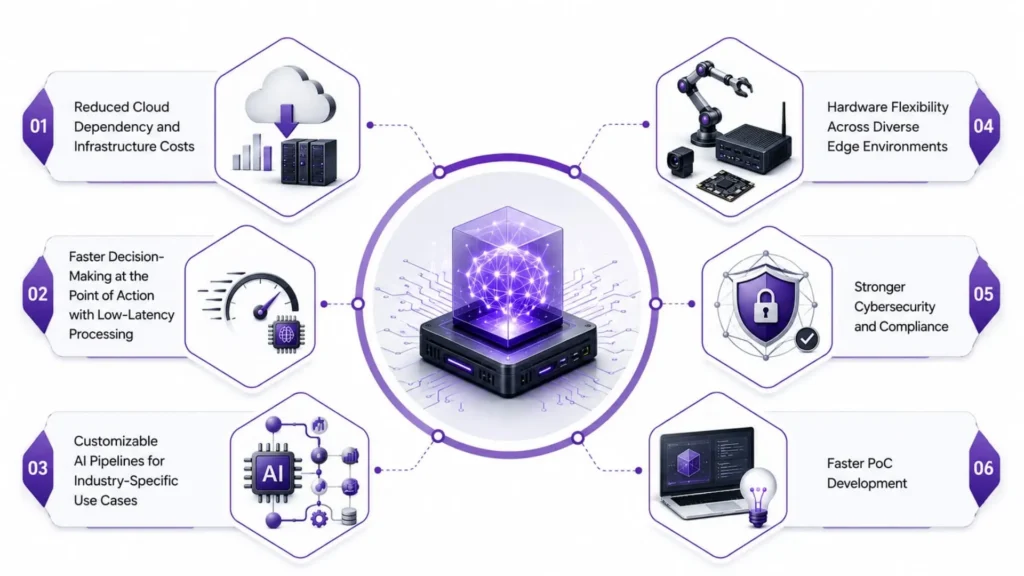
- Reduced Cloud Dependency and Infrastructure Costs: When intelligence moves to the edge, organizations are no longer routing every workload through centralized cloud servers. That alone brings down bandwidth costs, reduces cloud compute spend, and keeps infrastructure overhead from ballooning as more devices come online across factories and field sites.
- Hardware Flexibility Across Diverse Edge Environments: One of the major advantages of open-source Edge AI ecosystems is the ability to run across multiple hardware architectures and silicon platforms. Enterprises are not restricted to a single vendor ecosystem and can optimize deployments across GPUs, NPUs, FPGAs, microcontrollers, and industrial gateways depending on workload requirements. This flexibility helps organizations scale Edge AI deployments more efficiently while maximizing existing infrastructure investments.
- Faster Decision-Making at the Point of Action with Low-Latency Processing: Because AI models run directly on edge devices, systems can process and respond to operational events in real time without depending on cloud round-trips. This low-latency inferencing enables immediate decision-making at the edge, which is critical in industrial environments where even milliseconds can impact safety, efficiency, and uptime. It is what makes practical applications such as predictive maintenance, early fault detection, breakdown prevention, and real-time worker safety monitoring possible at scale.
Open-Source Edge AI Models Adoption for Enterprise
- Stronger Cybersecurity and Compliance: When data never leaves the facility, there is far less to protect from the outside. Sensitive operational data, equipment metrics, and process parameters stay on-site, which shrinks the attack surface and makes it considerably easier to meet compliance requirements in industries like manufacturing, energy, and critical infrastructure.
- Customizable AI Pipelines for Industry-Specific Use Cases: Open-source frameworks allow engineering teams to customize AI models, data pipelines, and inferencing workflows based on their operational requirements. Organizations can fine-tune models for specific manufacturing processes, environmental conditions, sensing configurations, or compliance requirements without depending entirely on proprietary AI ecosystems. This level of customization enables faster innovation and better alignment with real-world industrial applications.
- Faster PoC Development: Open-source Edge AI frameworks and pre-built model ecosystems significantly reduce the effort required to move from experimentation to a working prototype. Engineering teams can quickly fine-tune existing models, validate use cases on real hardware, and accelerate deployment without building AI pipelines entirely from scratch. This shortens development cycles, reduces engineering overhead, and enables organizations to bring industrial AI solutions to production much faster.
Together, these advantages are changing how enterprises approach AI deployment. Open-source Edge AI models are no longer just tools for experimentation.
MosChip DigitalSky GenAIoT‘s Cognitive Intelligence Suite bridges the gap between raw data and actionable insights by seamlessly embedding open-source Edge AI models onto the factory floor. This powerful combination eliminates cloud latency, enabling industrial systems to make critical, real-time operational decisions locally while improving scalability and deployment flexibility.
By leveraging open-source Edge AI ecosystems, enterprises gain faster customization, freedom from proprietary vendor lock-in, and access to proven frameworks and community-driven innovation. This allows organizations to accelerate AI adoption, optimize deployments more efficiently, and scale industrial AI solutions confidently across real-world operating environments.
To know more about MosChip’s capabilities, drop us a line, and our team will get back to you.