
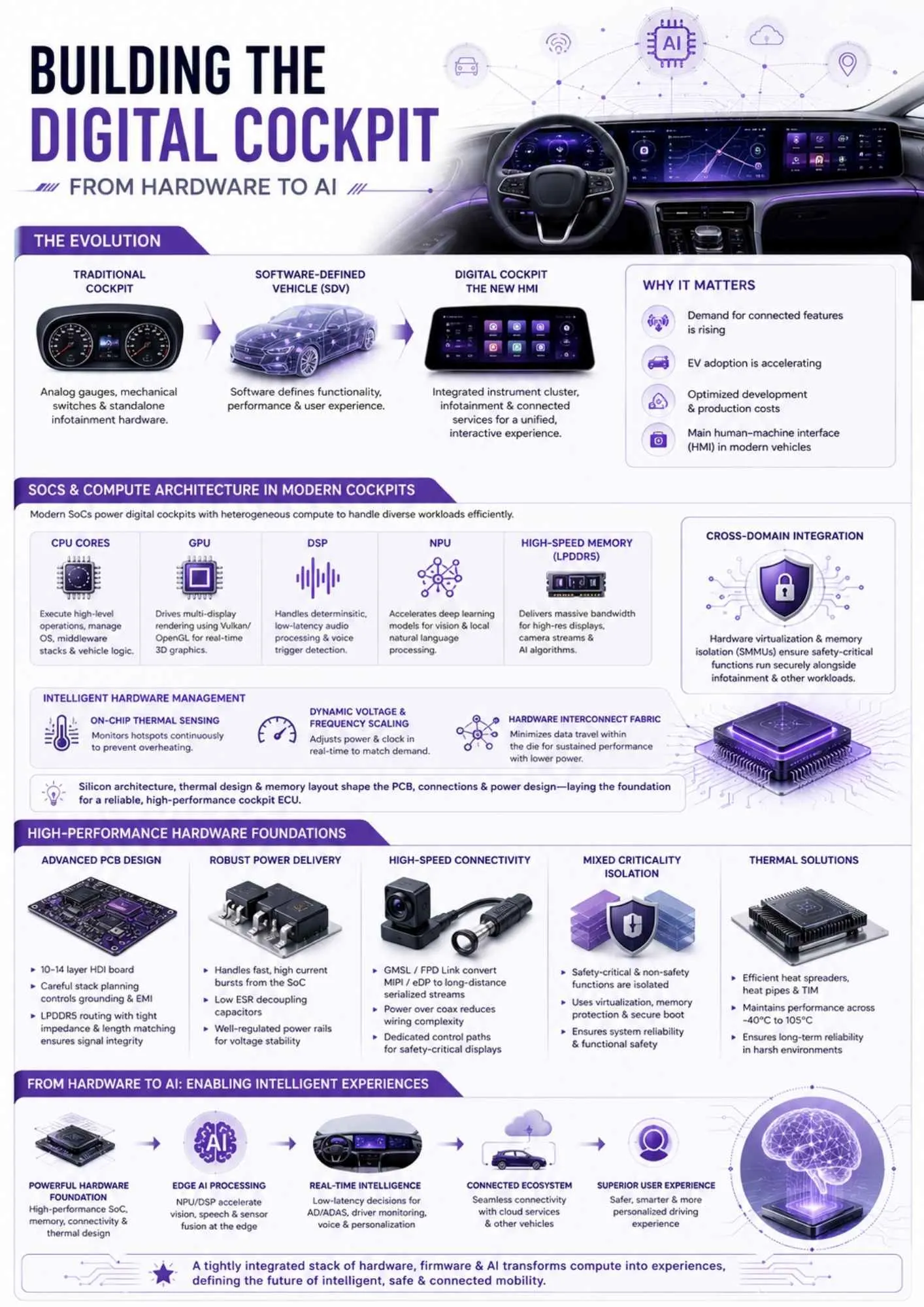
Traditional automotive cockpits relied on analog gauges, mechanical switches, and standalone infotainment hardware. These systems typically remained static after the vehicle left the factory.
Today, vehicles are evolving into Software-Defined Vehicles (SDVs), where software determines functionality, performance, and user experience. This shift is driven by increasing demand for connected features, the rise of electric vehicles, and automakers’ need to optimize development and production costs.
In this context, the digital cockpit has become the primary human–machine interface (HMI), integrating instrument clusters, infotainment displays, and connected services into a unified and interactive user experience.
Delivering this level of integration requires a tightly coupled technology stack that combines high-performance compute platforms, robust device software, and edge AI capabilities.
At the heart of this stack lies the underlying compute architecture, which forms the foundation for how cockpit functions are processed, managed, and scaled.
SoCs and Compute Architecture in Modern Cockpits
The modern digital cockpit is a high-performance computing platform behind the dashboard, replacing multiple isolated ECUs with centralized compute architectures powered by automotive-grade SoCs designed for cockpit and infotainment applications.
These platforms typically combine high-performance CPU clusters, powerful GPUs, AI accelerators, and dedicated multimedia engines to support demanding in-vehicle workloads.
To handle diverse workloads simultaneously, these platforms depend on a heterogeneous compute architecture. Instead of processing all data on a single chip, the SoC routes specific tasks to specialized, hardware-accelerated processing blocks:
- CPU Cores: Execute high-level operations, managing the guest operating systems, middleware stacks, and general vehicle logic.
- GPU: Drives multi-display rendering, utilizing Vulkan or OpenGL APIs to handle real-time 3D instrument clusters and expansive pillar-to-pillar interfaces.
- DSP: Focuses on deterministic, low-latency audio processing, executing acoustic echo cancellation, active cabin noise suppression, and voice-trigger detection.
- NPU: Accelerates deep learning models at the edge, utilizing dedicated matrix-multiplication pipelines for computer vision and local natural language processing.
Dedicated data paths move workloads to the correct compute block, while ultra-fast LPDDR5 memory channels deliver the necessary memory bandwidth to process multiple high-resolution camera streams, graphic layers, and AI algorithms without data bottlenecks.
Modern SoCs enable cross-domain integration through hardware virtualization and memory isolation. Features such as System Memory Management Units (SMMUs) partition compute, memory, and peripherals into separate domains, ensuring safety-critical functions like instrument clusters and driver monitoring remain isolated and protected from faults in infotainment or other non-safety applications.
However, running these high-performance compute blocks within an enclosed dashboard introduces intense physical constraints. To safely deliver high processing power across extreme automotive temperatures ranging from -40°C to 105°C, the silicon relies on intelligent hardware-management features:
- On-Chip Thermal Sensoring: Continuously tracks temperature at critical hotspots within the chip to prevent localized overheating.
- Dynamic Voltage and Frequency Scaling: Constantly adjusts power and clock frequencies in real-time to match processing demands.
- Hardware Interconnect Fabric: Minimizes data transit distances within the die to maintain sustained compute throughput without increasing power consumption.
These silicon-level architectures do not exist in a vacuum. The design of the chip, its thermal constraints, and its memory layout directly dictate the physical layout of the circuit board and its wiring.
Because the physical hardware must support these intense electrical requirements, the next phase of development transitions naturally into designing the physical circuit boards, high-speed camera connections, and isolated power supplies.
High-Performance Hardware Foundations
Once the silicon platform is chosen, the next step is to turn that raw compute capability into a reliable cockpit ECU that can handle mixed critical workloads in a real automotive environment.
It begins with the PCB, which acts as the electrical backbone of the system. To support high data rates, the design typically uses a 10-to-14-layer HDI board. This is where careful layer stack planning helps control grounding and EMI, while LPDDR5 memory routing demands tight impedance control and precise length matching. At these speeds, even small mismatches can lead to timing errors, so signal integrity becomes essential for overall reliability.
At the same time, the power delivery network must be designed to keep up with the SoC. As workloads increase, the chip draws fast and high bursts of current. To handle this, low Equivalent Series Resistance (ESR) decoupling capacitors and well-regulated power rails are placed close to the load, ensuring stable voltage even during sudden changes in demand.
With compute and memory stabilized, the design expands to handle high-speed data movement across the vehicle. Technologies like GMSL and FPD Link are used to convert MIPI or eDP outputs into serialized streams that can travel over longer distances. To reduce wiring complexity, power over coax is introduced so that power and data share the same link. Alongside this, dedicated control paths are added to maintain safety for critical displays such as the instrument cluster.
As the system grows, mixed criticality becomes a key requirement. Safety-critical and non-safety functions are isolated using a combination of architectural techniques rather than relying solely on physical separation. This can include safety islands within the SoC, independent PMIC power domains, redundant watchdog mechanisms, and freedom-from-interference designs. In addition, partitioned software architectures help ensure that essential functions continue to operate reliably even if infotainment or non-critical systems fail.
Next, the ECU connects to the rest of the vehicle. High-speed interfaces like Automotive Ethernet and PCIe support large data transfers, while CAN FD and LIN connect to existing systems through a safety MCU that filters and validates incoming data. Camera inputs, such as driver monitoring and surround view, are brought in through SerDes and fed into MIPI interfaces, enabling low-latency AI processing on the SoC.
Finally, all of this must work within tight physical limits. Thermal and EMC design play a critical role here. With SoC power ranging from 15 to 40 watts, heat is managed using thermal interface materials and metal enclosures. At the same time, shielding and filtering are used to meet automotive EMC requirements like CISPR 25.
At this stage, the hardware is fully connected and functional. However, it is still just a capable platform. It now needs a tightly integrated software stack to bring everything to life, manage resources, and coordinate all cockpit functions.
Device Software & Architectural Abstraction
Once the hardware is ready, it’s still just a powerful platform sitting idle. The software stack brings the cockpit to life by managing resources, enforcing safety, and enabling all user-facing features. To handle this complexity, modern cockpits use a layered, mixed-criticality architecture built around a service-oriented approach (SOA).
At the lowest level, everything starts with a Type-1 hypervisor, which runs directly on the hardware. Think of it as the system controller; it splits the SoC into isolated domains, assigning CPU cores, memory, and peripherals to each function. This ensures that safety-critical tasks (like the instrument cluster) are fully isolated from non-critical ones (like infotainment), while still allowing controlled data exchange between them.
On top of this, multiple operating systems run side by side. A real-time safety OS (such as QNX or INTEGRITY) handles the cluster and HUD, where timing and reliability are critical. At the same time, a feature-rich OS like Android Automotive or Linux powers infotainment, apps, and connectivity features.
To make everything work together smoothly, a middleware layer sits in between. It abstracts hardware complexity and standardizes communication, AUTOSAR Adaptive manages high-level services and system coordination, while AUTOSAR Classic handles real-time signals like CAN/LIN. Meanwhile, the Android HAL connects apps to vehicle functions, such as climate control, media, navigation, calls, vehicle health status, etc.
Finally, at the top, the application and HMI layer delivers the user experience. Frameworks like Qt, Kanzi, or Unreal Engine render rich, real-time interfaces across multiple displays. Importantly, the system ensures that critical information is always prioritized, regardless of what’s happening in infotainment.
Together, this stack turns the hardware into a safe, scalable, and upgradable cockpit system, naturally setting the stage for connected services and AI-driven intelligence.
The Digital Layer & Connected User Experience
Once the software stack is up and running, the cockpit becomes a fully functional system. However, to make it continuously evolving, connected, and scalable, it needs a strong digital backbone. This is where the digital engineering layer comes in, it connects the in-vehicle system with the cloud and manages the complete data lifecycle, from data generation to update deployment.
At a high level, this layer creates a closed-loop pipeline:
Vehicle → Data Collection → Cloud Processing → OTA Updates → Back to Vehicle
1. In-Vehicle Data Generation & Edge Processing
Everything begins inside the cockpit, where the system continuously generates data:
- System-level → CPU/GPU load, memory usage, thermal status
- Application-level → UI performance, crashes, response time
- Sensor-level → driver monitoring, usage patterns
Instead of sending everything to the cloud, the system performs edge processing:
- Filters only critical events and anomalies
- Compresses and aggregates logs
- Reduces unnecessary data transmission
This ensures efficient bandwidth usage while still capturing meaningful insights.
2. Secure Connectivity & Vehicle Boundary
Once processed, data needs to move securely to external systems such as cloud platforms, backend servers, and mobile devices. This is handled through reliable connectivity and strong security controls:
- eUICC (eSIM) enables global 4G/5G connectivity
- Wi-Fi used for high-bandwidth updates when available
At the same time, the vehicle boundary enforces cybersecurity (ISO 21434):
- TLS 1.3 / mTLS → encrypted communication
- Hardware Security Module (HSM) → secure key storage and authentication
- Internal firewall → isolates critical networks
This ensures that only trusted systems can access vehicle data or send updates.
3. Cloud Backend & Digital Twin
Once data reaches the cloud, it becomes part of a larger development and validation ecosystem:
- Digital Twin environments
-
- Virtual replicas of cockpit hardware and software that simulate OS behavior, user interfaces, and failure scenarios to enable early validation and testing
- CI/CD pipelines
-
- Automatically run functional, regression, and safety tests
- Enable faster and continuous software releases
This allows engineers to develop and validate software without waiting for physical hardware, reducing development cycles significantly.
4. OTA Update Orchestration
After validation, updates are deployed back to vehicles through a secure OTA pipeline:
- A/B partitioning
-
- One partition runs the current system
- Second partition receives update
- Instant rollback if failure occurs
- Uptane framework
-
- Multi-signature validation
- Protects against malicious or corrupted updates
This ensures updates are safe, reliable, and non-disruptive.
5. Continuous Feedback Loop
All these pieces come together to form a closed feedback system:
- Vehicle sends telemetry → cloud analyzes performance
- Cloud improves software/models → pushes updates
- Vehicle continuously improves over time
With this digital pipeline in place, the system is no longer static. It becomes data-driven and adaptive, naturally leading to the next layer: AI and intelligent features, where this data is used to enable real-time decision-making and personalized user experiences.
The AI Edge & Contextual Cockpits
With the digital layer already enabling secure connectivity, telemetry pipelines, and OTA-driven updates, the cockpit now has access to continuous real-time and historical data. The AI layer builds on this foundation to transform raw data into low-latency, context-aware intelligence, primarily executed on the SoC’s NPU and hardware accelerators to meet automotive constraints on latency, privacy, and reliability.
The system continuously ingests inputs from infrared DMS/OMS cameras, ToF sensors, microphone arrays, and vehicle networks (CAN/Ethernet). These inputs are processed using optimized, quantized (INT8) deep learning models.
Vision pipelines extract driver state (eye gaze, blink rate, head pose, drowsiness) and occupant context, enabling real-time safety features such as alerts and adaptive airbag deployment.
In parallel, audio pipelines leverage DSP + NPU acceleration for beamforming, noise suppression, and edge-based ASR/NLU, ensuring deterministic voice interaction even in noisy cabin conditions, with optional cloud LLM support for complex queries.
These independent signals converge through multi-modal fusion, combining vision, audio, and vehicle context to generate intent-aware decisions and predictive personalization, often using temporal models like RNNs or lightweight transformers.
Importantly, this intelligence extends beyond HMI; AI outputs, such as driver readiness indices, are shared with ADAS to enable safe control transitions in Level 3 automation.
All this data is setting the stage for the next big leap into true Agentic AI. Tomorrow’s vehicles will act like smart digital companions that figure out what you need before you even ask and constantly learn from your driving habits. Running these smart systems directly on the car’s built-in chips changes the dashboard from a basic control screen into a living, evolving system.
Because this new AI technology must handle everything from sensing the cabin to making split-second choices, your car needs a deeply connected system to run smoothly. This is exactly where MosChip’s Integrated Full Stack Automotive Engineering Edge comes in to tie everything together.
MosChip’s Integrated Full-Stack Automotive Engineering Edge
MosChip addresses these challenges by offering automotive engineering services that span ASICs to AI, ensuring a streamlined and well-coordinated development process across teams.
This includes finding and testing the right silicon for your specific vehicle class, building the high-speed cockpit ECU, and smoothly blending complex pieces like hypervisor partitioning, Android, AUTOSAR, and ISO 26262 safety standards. We even handle your secure connectivity and over-the-air (OTA) update channels.
When you want to bring next-generation intelligence into the car, our DigitalSky GenAIoT and AgenticSky suites optimize and deploy your AI models, including generative AI, directly onto the chip you picked. You never have to worry about whether your smart software will fit your real-world hardware.
By aligning hardware and software development within a coordinated workflow, integration challenges can be identified and addressed earlier in the process. This helps reduce rework, improve system stability, and enables the delivery of a digital cockpit platform that is better optimized for specific vehicle requirements and user expectations.
To know more about MosChip’s capabilities, drop us a line, and our team will get back to you.