
A newly published UHD World Association standard writes JPEG XS directly into its 8K programme-file requirements — a concrete signal of where large-scale UHD broadcasting is heading.

China's UHD World Association (UWA) has published a new technical standard — T/UWA 012.1-2023 — defining the video, audio, and file-packaging requirements for the "Bai Cheng Qian Ping" ("a hundred cities, a thousand screens") initiative: an ambitious public broadcasting project delivering 8K UHD HDR video and 3D audio to large public screens across more than a hundred Chinese cities. Buried in its technical tables is a detail worth highlighting for anyone working in broadcast infrastructure: for 8K UHD programme files, the standard mandates JPEG XS (ISO/IEC 21122-2), High 444 12 Profile, wrapped in MXF OP1a.
Why this matters
The standard draws a clear line between its 4K and 8K requirements. For 4K UHD content, it specifies XAVC-I — an older conventional intra-frame broadcast codec. But once resolution steps up to 8K (7680×4320), the requirement shifts to the more recent JPEG XS , at a specified intra-frame bitrate of roughly 2073.6 Mbps, still packaged inside the same MXF OP1a container that the rest of the workflow already uses.
| 4K UHD | 8K UHD |
| 3840 x 2160 | 7680 x 4320 |
| XAVC-I | JPEG XS High.444.12 |
| >500 Mbps | 2073 Mbps Intra-frame |
That distinction reflects exactly the problem JPEG XS was designed to solve. At 8K, data rates and processing loads scale dramatically, and production and playout systems need a codec that is:
- Visually lossless, so mezzanine-quality material can move through multiple encode/decode generations — capture, editing, storage, distribution to hundreds of display sites — without the cumulative artifacts of lossy inter-frame compression.
- Low-latency and low-complexity, since it's intra-only (every frame coded independently), which matters for a system feeding live 8K signals to large-screen networks in near real time.
- A clean fit for existing file-based and IP workflows, since MXF wrapping (OP1a, KLV-encoded, per SMPTE ST 377-2, ST 378M, and ST 379-2) is already the backbone of professional broadcast file exchange — JPEG XS sits naturally inside the same container tools already used for 4K. JPEG XS is the standard for live IP production used in ST 2110, VSF TR07, IPMX, etc...
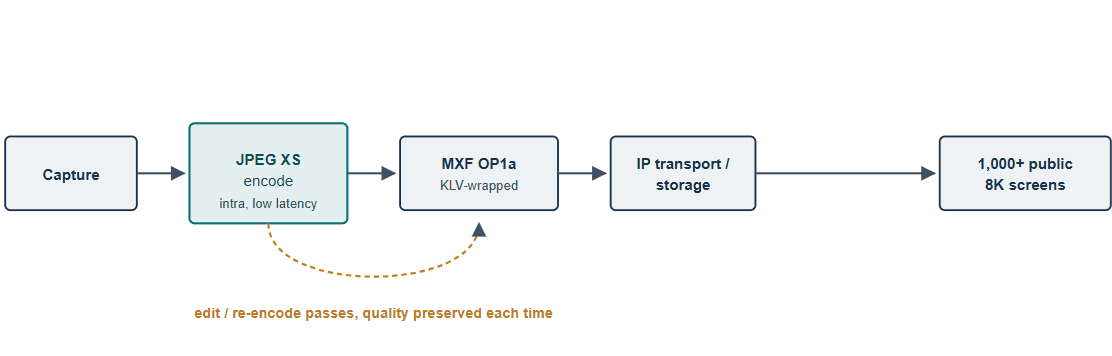
A simplified production-to-display path. Because JPEG XS is visually lossless and sub-intra-only, content can be decoded, edited, and re-wrapped in MXF multiple times without the compounding artifacts typical of long-GOP delivery codecs. Moreover it can be sent over ST2110 & VSF TR07 networks
For an initiative broadcasting to public screens at this scale, quality retention across a heavy production pipeline, manageable file sizes at 8K, and drop-in compatibility with the MXF/KLV tooling the industry already relies on are exactly why a standards body would choose JPEG XS over a more conventional, higher-compression codec.
How JPEG XS sits inside the MXF file
The standard is specific about the wrapping, not just the codec: files must comply with SMPTE ST 377-2 (file format), ST 379-2 (constrained general container), and ST 378M (Operational Pattern 1a — single item, single package), with KLV (Key-Length-Value) data encoding throughout. In practice, that means the JPEG XS elementary stream becomes just another essence track inside a standard MXF OP1a structure — the same structural pattern already used for 4K XAVC-I files in the same workflow.
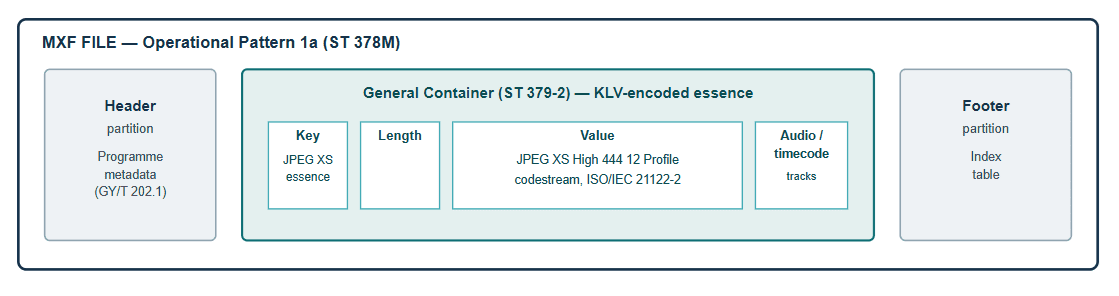
JPEG XS essence sits as a standard KLV-encoded track inside the same MXF OP1a container structure (SMPTE ST 377-2 / 378M / 379-2) already used elsewhere in the workflow — no bespoke wrapping required.
A signal of broader adoption
T/UWA 012.1-2023 is a concrete example of JPEG XS being written directly into a national broadcasting standard's file-format requirements for large-scale UHD delivery—not just used ad hoc, but formally specified alongside SMPTE MXF standards as the codec of record for 8K programme exchange. It's a useful data point for broadcasters and system integrators evaluating codecs for next-generation UHD file-based workflows, and it reinforces JPEG XS's role as a mezzanine/production codec for content that has to survive many hops between capture and screen without visible quality loss.
The full standard (T/UWA 012.1-2023, English translation) is available from the UHD World Association.
Source: UHD World Association, T/UWA 012.1-2023 — Technical requirements of programme broadcasting of UHD video and audio broadcasting system for "Bai Cheng Qian Ping."