
Executive Summary
A secure SoC design is only valuable if its trust model survives every transition: integration, manufacturing, deployment, updates, ownership changes, and end of life. This is the challenge of trust continuity.
It applies to every secure SoC and becomes more complex with chiplets, which add providers, integration points, ownership boundaries, and trust assumptions across the supply chain. As embedded systems become more connected and autonomous, manufacturers need a way to preserve trust from design and integration through manufacturing and lifecycle operations.
Securyzr™ iSE and Securyzr™ Server address two inseparable dimensions of this challenge. Securyzr™ iSE provides a hardware Root of Trust inside the SoC or chiplet. Securyzr™ Server provides the platform, onboarding, and provisioning services needed to prepare, govern, and securely transfer the assets on which that trust depends. Together, they help manufacturers preserve trust from design and integration through manufacturing and into the product lifecycle.
Download SecuryzrTM Server product information
WHY: A Secure Design Is Only the Beginning
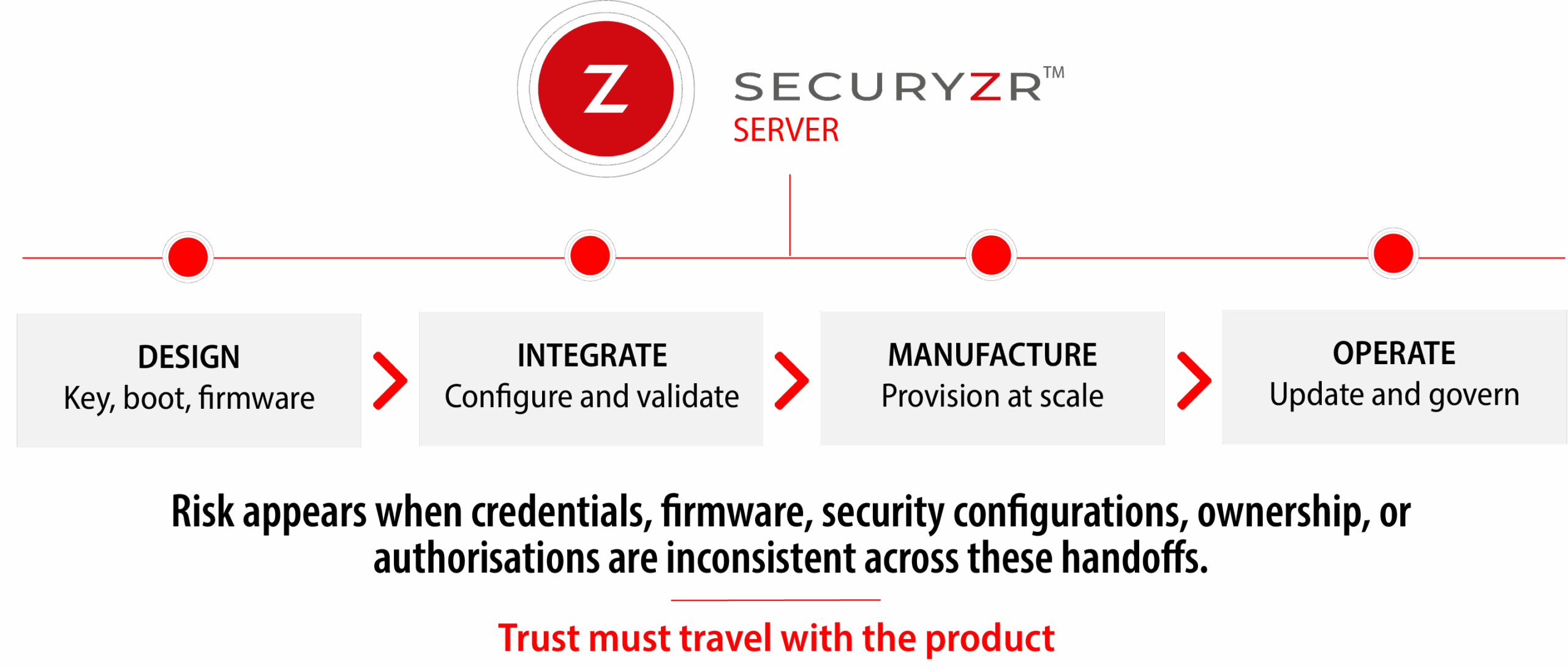
A semiconductor manufacturer may invest significantly in security architecture, integration, validation, and certification readiness. Yet the product can still be exposed if credentials are mishandled, firmware is replaced, provisioning assets are leaked, ownership is improperly transferred, or security configurations differ between validation and production.
Securyzr™ iSE provides the hardware-rooted foundation for trusted execution, including secure boot for the iSE and host CPU, secure key storage and provisioning, device authentication, secure debugging, anti-tampering, security monitoring, and cryptographic services.
But hardware-rooted trust depends on assets and processes outside silicon. Keys, certificates, firmware images, security configurations, authorizations, and ownership credentials must be created and tested before tape-out, securely delivered during production, and managed after products enter the field. For example, if a production SoC still trusts a development or debug public key, compromise of the corresponding private signing key could enable an attacker to sign unauthorized firmware; an already signed debug image could also be accepted without any private-key compromise. Secure boot would still verify the image correctly, but against an authorization policy that permits development software in production, potentially exposing privileged debug functions or enabling unauthorized code execution.
Trust can also break during manufacturing. If valid ownership or configuration commands are not bound to a specific device and authorized production scope, a compromised or misused provisioning environment could replay them onto additional chips. Those devices may carry accepted credentials and authentic firmware, undermining volume control, product authenticity, revenue protection, and traceability.
The challenge is therefore not simply to establish trust inside a device. It is to prevent trust from breaking between lifecycle stages.
Chiplets and Physical AI Increase the Pressure
Chiplet architectures amplify this challenge. A product may combine components from different providers and pass through SoC integration teams, foundries, OSATs, system manufacturers, and OEMs. Every additional relationship increases the importance of protecting intellectual property, authenticating components, controlling access, and maintaining traceability.
Physical AI raises the stakes further. Industrial AI devices, robotics, intelligent infrastructure, and other systems that interact with the physical environment depend on trustworthy processors, firmware, identities, and security configurations. A break in that trust can therefore affect not only data, but also the integrity and availability of systems acting in the physical world.
For their manufacturers, a compromised component may create more than a data-security problem. It can undermine product authenticity, operational availability, software integrity, and confidence in the complete system.
HOW: Preserve the Same Trust Model Across Every Stage
Trust continuity starts during design and integration.
Securyzr™ Server Onboarding enables teams to generate and test development keys, certificates, security configurations, boot ROM content, and signed or encrypted firmware across simulation, emulation, FPGA, and CI/CD environments. These pre-silicon assets validate the intended trust model; production assets are generated separately under production-specific policies and controls. Production boot configurations trust only explicitly authorized production public keys, the corresponding private signing keys remain protected, and debug access is governed separately.
Once the design is validated, the same governed workflow—not the same credentials—can prepare production-specific assets. This preserves the validated security intent while reducing configuration drift, late integration issues, and manufacturing friction.
During manufacturing, Securyzr™ Server Provisioning manages and tracks device keys and certificates and securely exports protected assets for injection. Binding provisioning authorizations to intended device identities helps prevent captured commands from being replayed onto unauthorized chips. Enforcing an authorized production scope additionally requires transaction controls, device tracking, and audit evidence. PKI, identity and access management, role-based control, audit logs, and HSM interfaces separate responsibilities and preserve evidence across organizational boundaries.
After manufacturing, the hardware and operational trust foundations support controlled firmware evolution, credential and certificate lifecycle activities, device ownership, and traceability. Securyzr™ iSE also supports secure and reliable software update mechanisms, including firmware authentication and protection against rollback to an older successfully replaced version.
This continuous approach can support cybersecurity programs related to the EU Cyber Resilience Act and automotive frameworks such as UNECE R155 and R156. Securyzr™ Server contributes lifecycle security capabilities, while compliance depends on each customer’s product scope, implementation, processes, and evidence.
Download SecuryzrTM Server product information
WHAT: One Trust Continuity Solution, Inside and Outside the Device
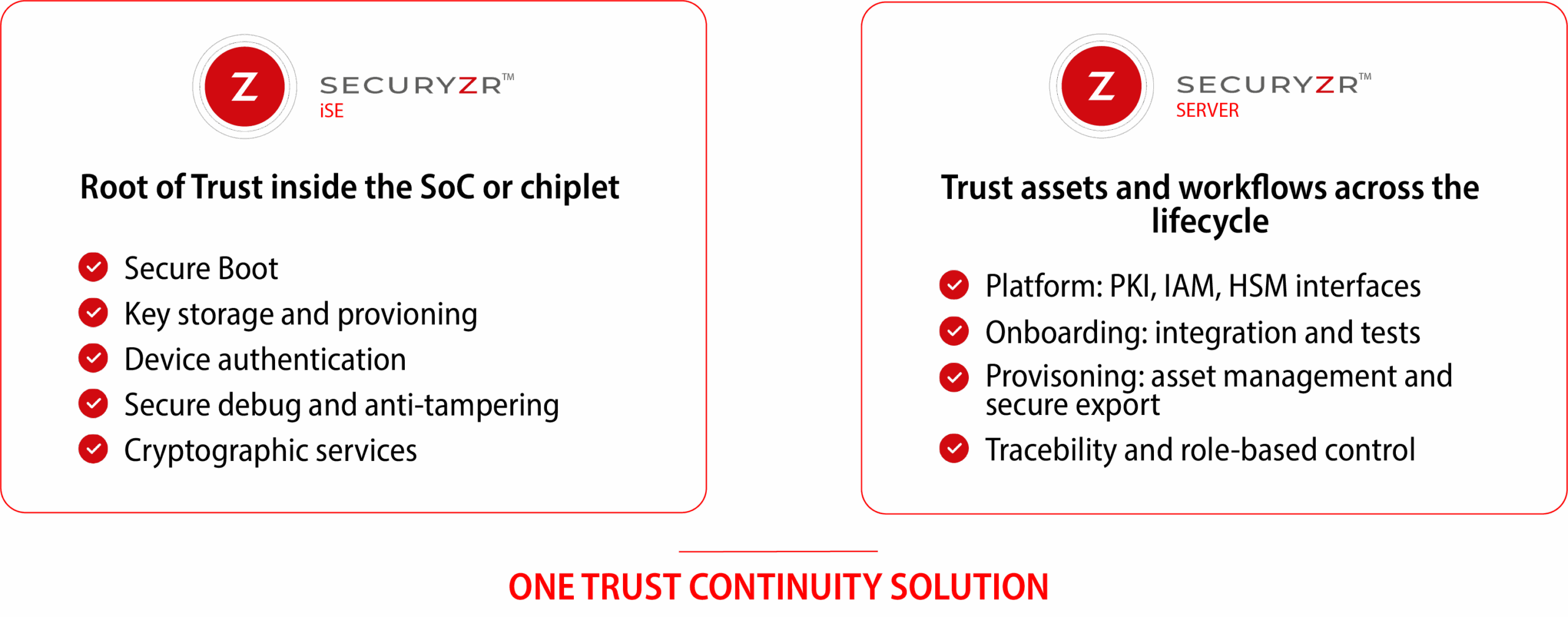
Securyzr™ iSE establishes and enforces trust inside the SoC or chiplet. It provides the secure element and Root of Trust functions needed to protect identities, keys, firmware, boot processes, and security-critical operations.
Securyzr™ Server operationalizes that trust across design, integration, manufacturing, and lifecycle workflows. Its three complementary components provide the platform infrastructure and PKI, pre-silicon onboarding and testing, and secure mass-production provisioning.
A concise trust-continuity model
- Design & Integration: Generate and test identities, security configurations, boot images, and protected firmware.
- Manufacturing: Manage, track, package, and securely export device assets for provisioning.
- Deployment and lifecycle: Maintain secure boot and update foundations, credentials, ownership, traceability, and revocation.
Together, they help chip and system manufacturers align pre-silicon validation with production provisioning, protect device identities and firmware, control roles and ownership transitions, and improve traceability across organizational boundaries.
Trust Should Not Be Recreated at Every Handoff
Chiplets distribute trust across more providers and handoffs. Physical AI increases the consequences of a compromised component. Regulations reinforce the need to maintain security throughout the product lifecycle.
In this environment, securing silicon is essential, but no longer sufficient.
Trust established during SoC or chiplet design must remain consistent through integration, manufacturing, provisioning, deployment, operation, and end of life.
Securyzr™ iSE and Securyzr™ Server provide the complementary foundations for that continuity: hardware-rooted protection inside the device and governed security assets and processes across its lifecycle.
Download SecuryzrTM Server product information
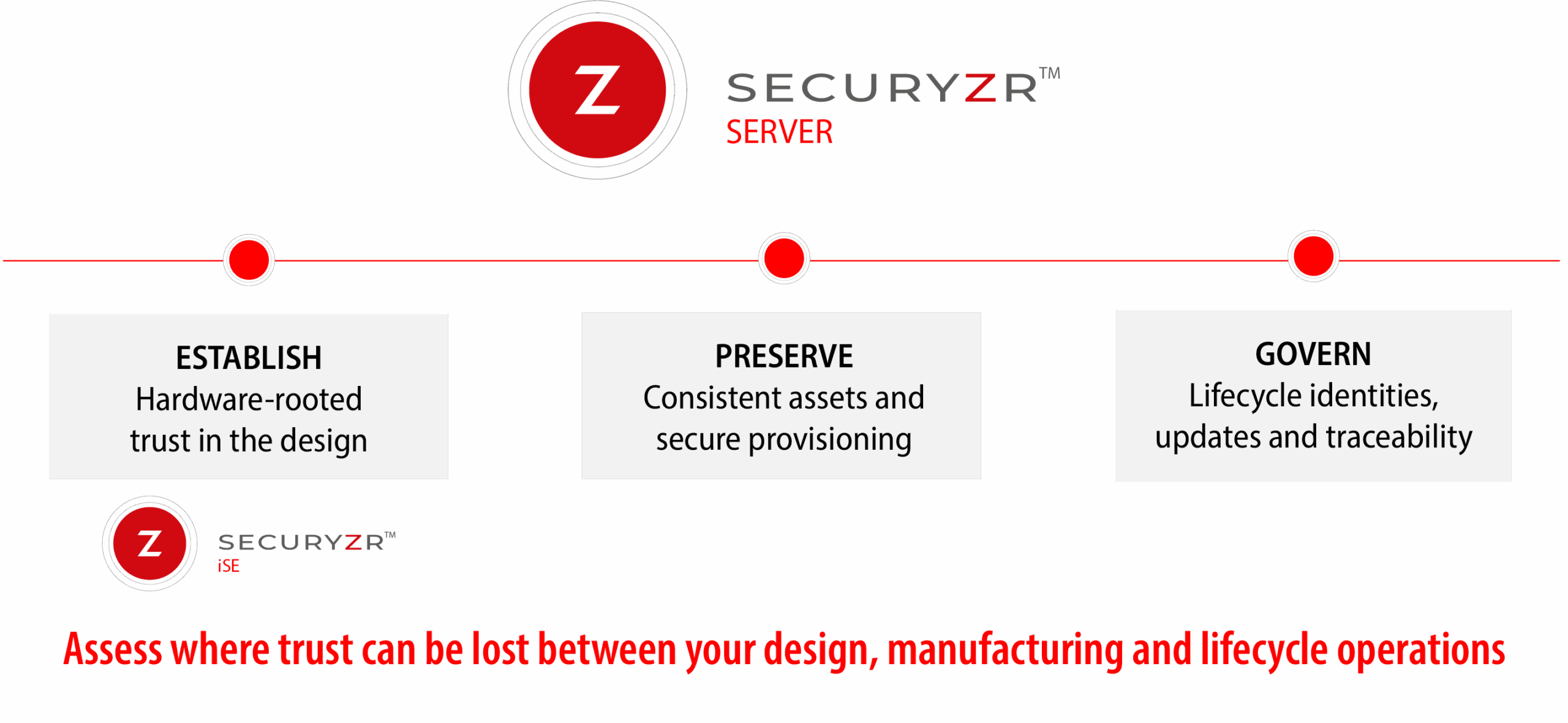
Discover where trust could be lost in your current product flow. Contact Secure-IC to assess how Securyzr™ iSE and Securyzr™ Server can support trust continuity from design to deployment and beyond.