
From Hardware to Application: Understanding the Role of HAL in Embedded Platforms
ByPradeep Kumar Chinthala27/10/2026
Suppose you are creating an embedded application and later need to alter certain sections of the firmware because there has been a change either to the processor or to a peripheral. Although the application logic could stay unchanged, the method in which the software accesses the hardware might be different from one platform to another.
The Hardware Abstraction Layer (HAL) offers software interfaces for hardware resources and separates application logic from a large part of the processor-specific implementation. The effectiveness of this approach relies on the hardware capabilities and on the behaviour required by the application.
How effective a HAL has usually come down to the hardware architecture decisions taken before firmware development starts. If the peripherals are consistently chosen, the interfaces are standardised, the clocking architecture is established, the power-domain design is carried out, and pin-multiplexing strategies are adopted, then the amount of software adaptation needed among different product variants can be greatly reduced and platform migration made easier.
Understanding the Hardware Abstraction Layer
When a program asks a sensor for data via I2C, the request goes through the software modules which are involved in communication with the peripheral. HAL offers an interface for this kind of operation, the actual implementation looking after the details that are specific to the controller.
The software architecture and the environment differ according to the platform and can consist of application code, middleware, or an RTOS, together with peripheral drivers and HAL functions. Generally, the Board Support Package (BSP) is responsible for the board-specific configuration and initialization and links the software setup to the requirements set out in the hardware design.
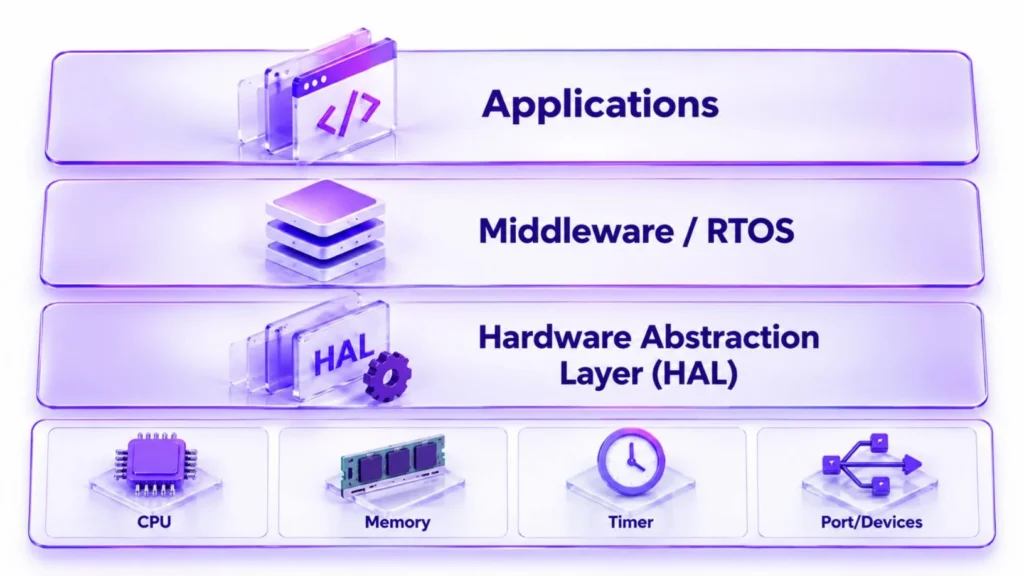
Figure 1: HAL Architecture
In systems based on Linux, hardware abstraction can also make use of a Device Tree configuration, which enables drivers to adjust themselves to various board implementations without needing any changes to the source code. This configuration layer supports the functions of the HAL and BSP by outlining the hardware resources and the way these resources relate to the operating system.
The various responsibilities are not always divided into separate parts; in some cases, the HAL functions are combined with the peripheral drivers, while in others the layers are kept separate. The key point is the position of each responsibility and the way the components interact.
Mapping Hardware Resources to Firmware Interfaces
Multiple peripherals perform different firmware operations, GPIO, UART, and SPI is for pins and enabling serial communication, and ADCs is for analog signals. Likewise, timers and PMW controllers control the timing-functions.
It is necessary for the interface to strike a balance between abstraction and access to features that are specific to individual peripherals. For example, an ADC may have multiple channels, a configurable resolution, and different sampling rates. The firmware requirements will decide which of these options should be accessible.
In fact, two SPI controllers might provide different transfer modes or configuration options. A device designed based on their common functions would not include all the features of both controllers. The problem then is to offer the operations that the application requires without unnecessarily limiting access to the hardware features available.
Hardware Dependencies in Peripheral Operation
The operation of a peripheral can be influenced by the clock settings, the reset state, the pin configuration, and the order in which it is initialized. Moreover, the fact that a peripheral is available may also be determined by the power-domain configuration, the clock-tree architecture, the voltage sequencing, and the reset dependencies that are built into the hardware design. These relationships are usually checked during board bring-up, when both the hardware and the firmware have to set up the conditions necessary for the peripheral to function properly. The peripheral may still fail even if the application logic is correct because the required conditions have not been met.
The implementation at the low level should consider these requirements as determined by the processor and the board configuration.
The use of transfer handling results in extra dependencies. When an operation is blocking, it has to wait until it is completed, whereas an asynchronous operation needs a means of being informed when it has finished or if an error has occurred. In the case of DMA, the transfer buffer has to be accessible to the controller and have to satisfy any alignment requirements. Systems which have data caches might also need cache maintenance in order to ensure that the data for the CPU and the DMA remains consistent.
The way in which the firmware handles a transfer is influenced by the fact that the data is still in use after the initial function call has returned.
HAL Across Board Configurations and Hardware Variants
Hardware revisions can alter the assignments of the GPIO pins, the power architecture, the clock sources, the choice of peripherals, the sensor devices, or the different types of processors. The way in which firmware is affected by each of these changes will depend on the level of abstraction and on the degree of hardware dependency involved.
An update to the configuration might be all that is needed for a pin reassignment. A replacement sensor might require a different driver in order to deal with its register map and communication sequence. In the case of moving to another processor, changes would have to be made to the platform initialization and to the peripheral implementation.
Since the firmware architecture is well defined, board configuration can be kept separate from the application logic and hardware changes thus become easier to manage. Yet it is possible that a new platform does not have a feature that the application relies on, or that the replacement device behaves in a different way. In these situations, the updates may have to go beyond the configuration and driver code.
Hence, the degree of reuse is determined not only by the fact that both platforms offer a HAL but also by the differences between the original and the replacement hardware.
Abstraction, Hardware Capabilities, and Performance
The way HAL is implemented will have an effect on latency, usage of memory, and size of the code. Although extra function call, data copying, and processing may make only a small difference in sensor applications. It must be examined in systems that carry continuous data streams and strict timing requirements.
Yet, HAL abstracts hardware interfaces, and its behavior depends on the underlying hardware architecture. The performance requires an abstraction layer to provide enough control to make effective use of the platform-specific capabilities.
A realistic design employs HAL for normal operations and restricts direct hardware access to those particular instances in which the extra control is appropriate. The choice should be based on the product’s timing and performance requirements rather than assuming that abstraction or direct access should be the default option for all operations.
HAL During Board Bring-Up and Product Validation
When the board is being brought up, the engineers have to decide if the failure is due to the firmware, the peripheral configuration, or the physical hardware.
Most problems arising in the area of bring-up are due to mistakes such as incorrect pin assignments, errors in clock configuration, difficulties with power sequencing, the absence of pull-up or pull-down components, signal-integrity problems, peripheral timing constraints, or incomplete firmware initialization. These problems are generally solved through combined debugging efforts by both the hardware and firmware teams.
If an I2C sensor fails to respond, the engineers might need to verify the device address, check the controller status, and use an oscilloscope to check for signal activity and timing. Carrying out these checks will allow them to tell whether the problem is due to software or to a fault at the board level.
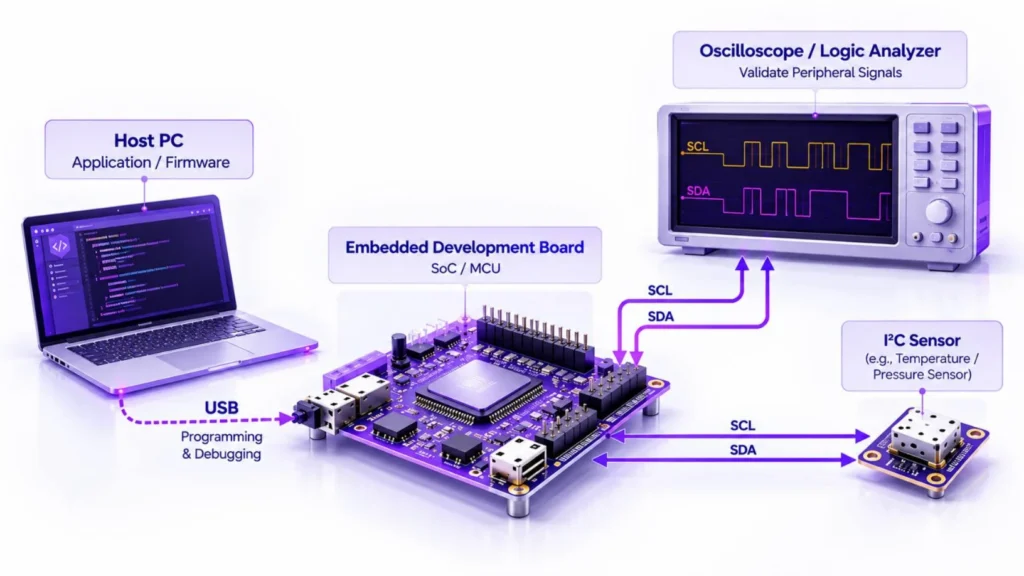
Figure 2: Embedded Board Bring-Up and Peripheral Validation
In addition to examining the behaviour of the firmware, the engineers usually check the power rails, the clock sources, the reset signals, and the interface waveforms in order to find out whether the failure is due to software, the board-level implementation, or problems at the component level of hardware.
Validation must also take into consideration the effects of hardware revisions. Tests which are still applicable can be reused, but those which are influenced by changed connections or components have to be updated. The test results must confirm that the integrated platform meets the final requirements, not just that a HAL function returns successfully.
On a closing note, HAL is used to find a balance between simplifying access to the peripherals and keeping the level of control to satisfy embedded products’ functional and performance requirements. Hitting this balance calls for concerning design interface, dependencies on the platforms, hardware performance optimization and architecture at each stage of firmware development, board-bring-up and product validation. Ultimately, the architectural choices made for both hardware and software impacts upon the portability, maintainability, and system performs for a long-term scalability.
MosChip works across the product engineering journey, supporting activities from board design, bring-up and BSP to peripheral driver development and firmware integration. This includes working with interfaces such as SPI, I2C, GPIO, and UART, along with embedded software development for Linux, RTOS, and bare-metal platforms.
The work involves hardware bring-up, integrating drivers, OS porting, and validating firmware on target platforms. This helps resolve hardware-software integration issues and get embedded products ready for further testing and development.