
While being involved in several discovery calls with different customers, we come across a very common question:
“Can you help us implement predictive maintenance?”
And that question has eventually culminated in several predictive maintenance implementations. Most organizations want to move from reactive maintenance to a system that can continually monitor asset health, identify anomalies, predict potential failure, and help maintenance teams react before the failure occurs. The reason- to achieve maximum uptime and keep production consistent.
If you look at the recent stats of the market, you will notice the growing demand for predictive maintenance. The global predictive maintenance market was valued at $14.29 billion in 2025 and is projected to reach $98.16 billion by 2033, growing at a CAGR of 27.9%. (Grand View Research, 2025)
Another observation we have had in our experience is that the applications may differ depending on whether it’s a manufacturing line, a motor, a compressor etc. but the underlying challenges across factory floors are remarkably similar.
As more predictive maintenance initiatives are being catered to, most times they are treated as completely different development projects.
Each project starts from scratch and the cycle repeats itself. We start with collecting sensor data (which could sometimes take several months), integrating the OT-IT systems, building data pipelines, developing machine learning models, creating dashboards, managing alerts, and validating results. But the reality is that by the time the solution is developed, the business has already lost significant amount of time and resources.
Do we have to really build predictive maintenance model from scratch every time?
Lets consider a motor, an industrial pump or even a compressor. Each of these machines have different operating characteristics and functions, different failure modes, and sensor configurations. But beneath all of this, the underlying predictive maintenance workflow will remain the same.
If you look at it data is acquired and the cleaned and contextualized, analyzed for abnormal patterns, passed through predictive models, and translated into actionable insights. Thene the system responds to the situation or raises an alert for the human to take recommended action.
The algorithms and the associated asset parameters will definitely differ, but many of the engineering components supporting this workflow can be reused.
Whats important is to separate the engineering foundation from the intelligence and configuration specific to each asset in your factory. But instead of reinventing the wheel again and again, your engineering teams can make use of reusable components and focus development efforts on the aspects that require customization.
If we are going the tradition route and starting from scratch, just collecting data sometimes takes several months. Because you have MES, historians, SCADA, PLCs, sensors etc. and you need to capture data from these sources, but you also need data from different operational conditions. If you have the historical failure data, it is actually valuable for supervised learning. But this data could be incomplete or in some cases unavailable.
Then the data is prepared for analysis as sensor readings may have different sampling frequencies. Inconsistent timestamps, noise among other things which need to be cleaned out.
The next part is feature engineering and model development. For example, in a vibration-based monitoring engineers may need to extract RMS amplitude, kurtosis, crest factor, and frequency domain features to understand changes in the machine behavior. Then based on the problem and available data, they may select anomaly detection algorithms, fault classifiers, regression, or time-series approaches.
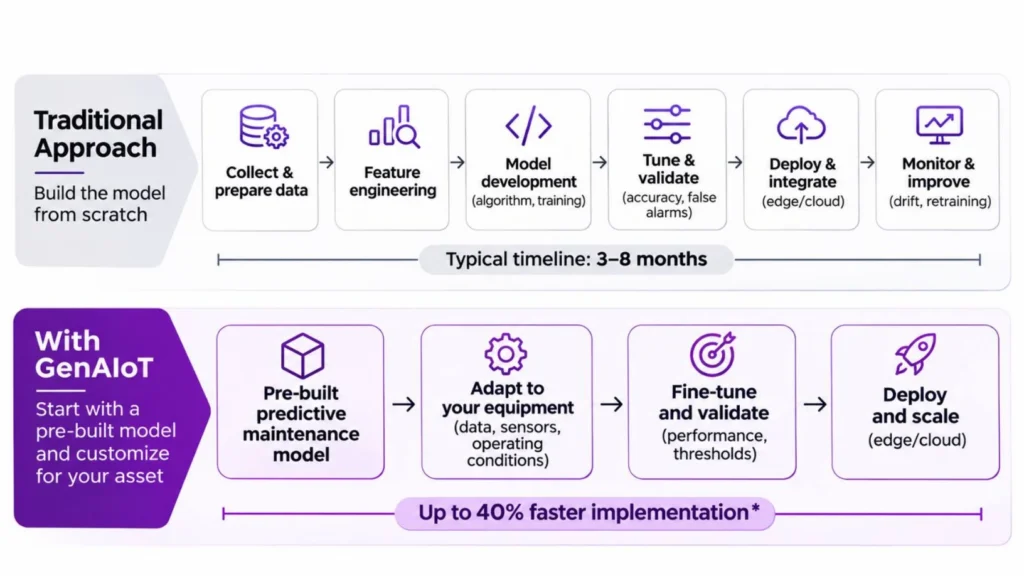
After this the model is trained, fine-tuned, and evaluated against the data that reflects the condition in which the machine will operate. Then it’s validated for false alarms, missed failures, detection lead time, and performance across various operating conditions.
Finally, the model must be integrated with a data pipeline, deployed on the edge or cloud environment, and continuously monitored post deployment.
This entire process could sometime take up to several months, depending upon how ready the data is, the equipment, and validation requirements. So, this leaves us with the important question- do we really have to repeat these steps every time?
So, can a predictive maintenance model be built beforehand?
A pre-built predictive maintenance model can provide you with a headstart by reducing the need for developing the entire machine learning pipeline from scratch.
Let’s take the example of vibration monitoring of an industrial motor. Instead of starting with algorithm selection, followed by model development and implementation, engineers can start with an existing model and its components, and then finetune it to their hardware and use case.
The focus is mainly on adapting the model for the target application.
However, you need to determine if the model is suitable for the machine and the requirements and based on that fine-tune or calibrate the model to make it adapt to your use case. Establish necessary thresholds and determine how the predictions will be used in the maintenance workflow.
A model developed for a specific environment and type of machines may not work for another. So, finetuning and validation will remain an essential part.
How GenAIoT accelerates predictive maintenance development?
This is the principal behind MosChip DigitalSky GenAIoT, a solution accelerator design to add necessary acceleration to development of intelligent and connected products.
As part of it, we have the Cognitive Intelligence Suite, which covers a myriad of use cases, right from audio, vision, image, and others, about 100+ foundational AI models and 50+ Edge AI models, which can be reused by fine-tuning them according to your product requirements and implemented faster. This suite also includes a predictive maintenance model too.
Basically, you can cut the time down by up to 40 percent depending on your product requirements? This reduces the initial development time, and more time in enhancing the user experience.
MosChip brings over 25 years of experience across silicon, hardware, software, digital, and AI, topped with solution accelerators such as GenAIoT, AgenticSky (for agentic devices across HMI, vision systems, control systems, wearables, robotic arms), and ProductXcelerate Blueprints (pre-validated hardware to AI reference designs). To know more about us, drop us a line and we can help you setup an introductory call with our engineering leaders.